
Matic Robotics: Why Hardware Startups Shouldn’t Create New Markets
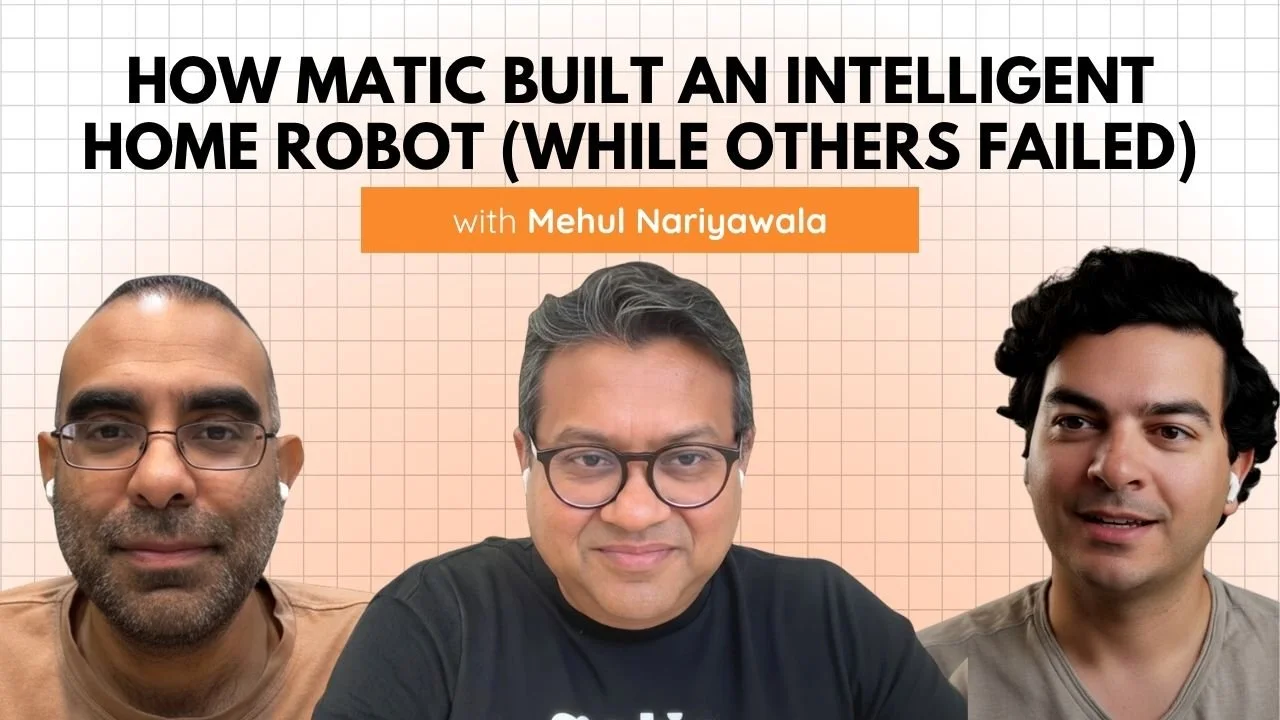
Matic Robotics co-founder Mehul Nariyawala joins Founders in Arms to break down why most hardware startups fail—and how his team is building a breakout robotics company by doing the opposite of conventional wisdom.
In this episode, Mehul shares hard-earned lessons from building at Nest and scaling Matic: why robotics is far harder than software, why creating a new market is a mistake, and how focusing on an existing but broken category unlocked a massive opportunity.
The conversation explores the realities of hardware, the importance of product-market fit in physical products, and why true innovation in robotics starts with perception—not flashy humanoids.
This conversation dives deep into:
Why hardware startups shouldn’t create new markets
Robotics vs. software difficulty (10x vs. 100x)
The failure of early robot vacuums
Negative-NPS markets as opportunity
Vision-only robotics vs. sensor-heavy approaches
Building defensible hardware businesses
In-house manufacturing and iteration speed
Why humanoid robots are overhyped (for now)
Product-led growth vs. paid acquisition
In this episode, we cover:
(00:00) Why creating a new market is a mistake
Mehul explains a core principle: hardware is already hard—creating a new market on top of that is exponentially harder.
Startups should enter existing categories, solve real problems, and earn trust before expanding.
(01:14) The idea behind Matic Robotics
After seeing hundreds of self-driving startups but no serious home robotics efforts, the team saw an opportunity.
They set out to build the “Apple of home robotics,” starting with a familiar form factor: the vacuum.
(02:20) The moment that exposed the problem
A $1,000 robot vacuum destroyed a rug—getting stuck and grinding in place.
This highlighted a core issue: existing robots weren’t intelligent—they were just automation without real perception.
(03:30) A massive market hiding in plain sight
Despite poor user satisfaction (negative NPS), robot vacuums kept selling—and growing ~16% annually.
This created a rare opportunity: a large, proven market with deeply flawed products.
(04:30) The “negative NPS” opportunity
Most founders chase loved products.
Matic did the opposite—targeting a category people actively disliked but still bought.
That combination (high demand + low satisfaction) is where breakthrough products can win.
(07:30) Designing for intelligence, not just utility
Even the unboxing experience was intentional—the robot rolls out of the box itself.
Why? Because movement signals intelligence and creates an emotional connection instantly.
(09:00) The missing piece: perception
Unlike self-driving cars (which rely on GPS + maps), home robots operate in unstructured environments.
Matic’s key insight: robots must understand homes the same way humans do—through vision.
(10:20) Why vision-only was a bold bet
The team chose to rely only on cameras, avoiding additional sensors.
Why?
Each sensor adds exponential complexity
More hardware = more failure points
Software can scale better than hardware
This mirrors Tesla’s approach to autonomy.
(14:00) Lessons from Nest: what makes hardware defensible
At Nest, they saw:
Thermostats → highly defensible (due to complexity + regulation)
Cameras → highly competitive (low barriers to entry)
The insight: the best hardware categories are difficult, unsexy, and hard to replicate.
(17:30) Why Matic chose robot vacuums
The category was:
Large and growing
Undifferentiated
Ignored by big tech
Painful for users
Perfect conditions for building a dominant company.
(18:50) Why startups should avoid creating markets
Trying to invent demand in hardware introduces massive risk:
Hard to predict supply/demand
High inventory exposure
Slow iteration cycles
Instead, start where demand already exists and improve the product.
(20:00) Why Matic manufactures in-house
Instead of outsourcing, they built their own factory.
Benefits:
Faster iteration cycles
Better control over quality
Reduced dependency on external timelines
They can now produce ~4,000 robots per month.
(24:00) The surprising scale of robotics
Robot vacuums are the only truly scaled consumer robotics category:
Tens of millions of units sold
Far ahead of other robotics segments
Everything else is still early-stage.
(27:00) Why robotics takes so long
The product took 4 extra years to ship.
Why?
Because robotics requires extreme reliability—far beyond typical software.
90% accuracy = demo
99% = alpha
99.99% = shippable
That last stretch is the hardest.
(29:00) Why productizing is harder than the demo
In robotics:
Demo = 20% of the work
Productization = 80%
Users expect near-perfect performance for everyday tasks like cleaning.
(31:00) The real goal: solving problems, not building robots
Customers don’t want robots.
They want clean floors.
If the robot doesn’t consistently solve the problem, the technology doesn’t matter.
(32:00) Scaling challenges in hardware
Unlike software, hardware scaling is constrained:
Supply chain decisions are made months in advance
Demand can’t be instantly fulfilled
Growth must be carefully managed
Matic intentionally throttles demand to match supply.
(33:00) Why they avoid paid marketing
Most hardware companies spend 30–40% of revenue on marketing.
Matic aims for near-zero.
Instead, they rely on:
Word of mouth
Product quality
Customer love
(37:00) Making an “uncool” category exciting
Early launches got little attention.
Only after shipping—and delivering a great product—did traction build.
A strong review (e.g., Wired) helped validate the product.
(38:00) Why humanoid robots are overhyped
Mehul believes humanoids will happen—but not soon.
Challenges:
Lack of clear use case
High cost ($10k+)
Insufficient reliability
Enterprise use cases will likely come first.
(41:00) Robotics is still in the research phase
The field is rapidly evolving:
Foundation models
Reinforcement learning
World models
But no clear breakthrough yet for general-purpose robotics.
Key Takeaways for Founders
Don’t create markets in hardware
Start with existing demand and improve the product.
Negative NPS can signal opportunity
If people buy something they dislike, there’s room to win.
Robotics is exponentially harder than software
Expect long timelines and extreme precision requirements.
Productization is the real challenge
A working demo is just the beginning.
Great products reduce marketing needs
Word-of-mouth is the strongest growth engine.
Focus on solving problems—not showcasing technology
Customers care about outcomes, not innovation for its own sake.
About the Guest
Mehul Nariyawala is the co-founder and president of Matic Robotics, a company building next-generation home robots powered by computer vision.
Previously, he worked at Nest (Google), where he led product development for camera systems, and co-founded Flutter, which was acquired by Google.
Listen to Founders in Arms
Founders in Arms explores the ideas shaping technology, startups, and the future of innovation.
🎙 Subscribe to Founders in Arms on your favorite platform.
💬 Join the conversation at TribeChat.com.
🚀 Discover more insights from founders and operators shaping the future of technology.
