
Anthropic's record IPO this week has a lot of Bay Area boards asking the same question: are we ready to go public? According to Silicon Valley lawyer Louis Lehot of Foley & Lardner, most companies that ask are about 12 months of work away from a good answer.
The window is wide open. Lehot's 12-month IPO readiness checklist notes that traditional IPOs raised about $114 billion in the first half of 2026, more than 7 times the same period a year earlier, across 65 listings. Here is that roadmap broken into 4 phases, with the founder decisions that tend to cause delays if you leave them late.
12 to 9 months out: audits, accounting and the board
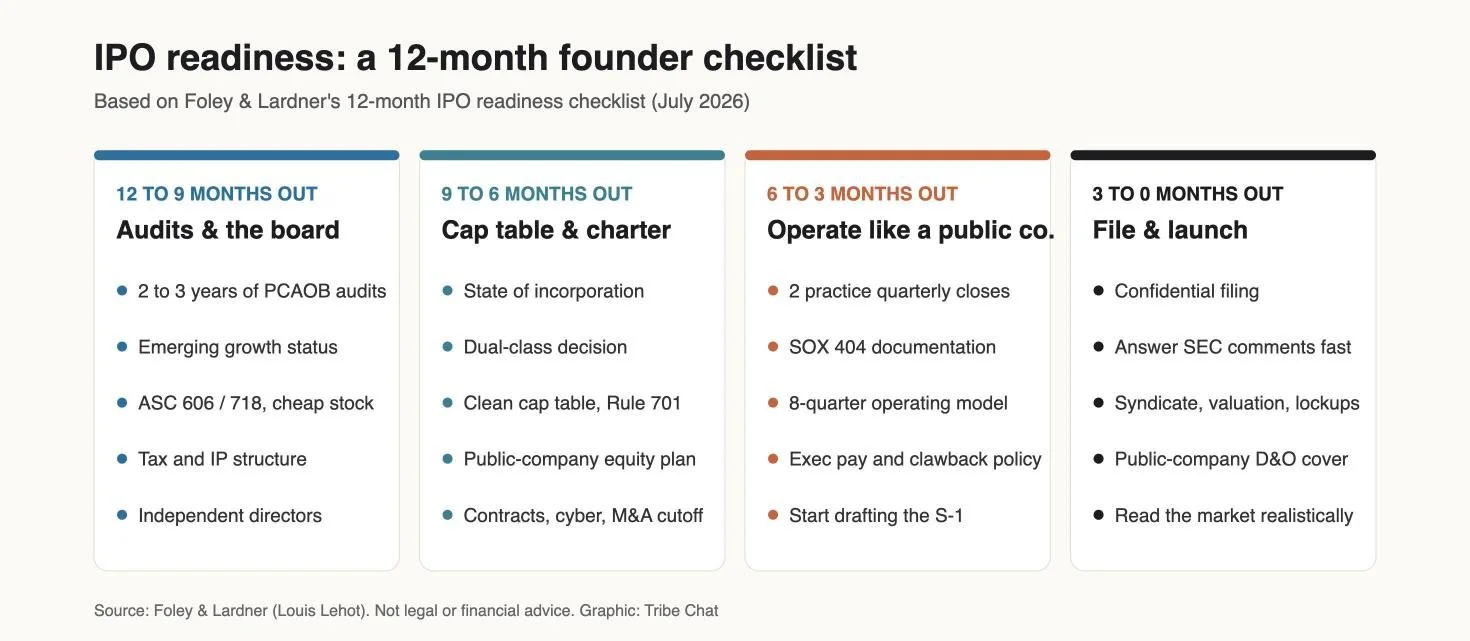
Start with the audit. You'll need 2 to 3 years of financial statements audited under PCAOB standards, the rules for public-company auditors. Most first-time issuers qualify as emerging growth companies, which the SEC's IPO investor bulletin defines as companies with under $1.235 billion in revenue, and that status allows 2 years of audited financials instead of 3.
Lehot flags the accounting areas that most often delay filings: revenue recognition under ASC 606, stock compensation under ASC 718, segment reporting and capitalized software. He also warns about "cheap stock," where the SEC compares recent 409A strike prices with the expected IPO price and questions big unexplained gaps.
Tax restructuring has the longest lead time, so it belongs in this first phase, including where your intellectual property lives and a Section 382 study on net operating losses. Rebuild the board at the same time. Exchanges require a majority of independent directors and independent audit and compensation committees, and recruiting a real financial expert for the audit committee takes months.
9 to 6 months out: cap table, charter and contracts
This phase is cleanup. Decide on your state of incorporation; Delaware is still the default, though Nevada and Texas amended their laws in 2025 to compete. Settle the charter terms too, including whether you want a dual-class structure, which Lehot notes cannot be added after the offering.
Anthropic shows how far founders can take control design. Its co-founders direct a single Class F share with 50.1% of the vote on key matters, according to a summary of Reuters' review of its prospectus. Whatever you choose, investors will judge it, so make the call deliberately.
Reconcile every line of the cap table, confirm Rule 701 compliance for old option grants, and read your investor rights agreement for registration rights and lockup expectations. Design the public-company equity plan, including the timing of any move from options to RSUs. Our guides on 83(b) elections and employee tender offers cover the earlier equity choices that make this step easier.
Lehot also recommends a cybersecurity and privacy review, a cutoff date for acquisitions, since a big deal mid-process can add months of extra audits, and a review of material contracts for change-of-control clauses, because many of them become public exhibits.
6 to 3 months out: operate like a public company
Run at least 2 practice quarterly closes on a public-company timeline, with draft earnings releases and a mock audit committee review. Build your SOX 404 internal controls documentation even if emerging growth status delays the auditor's sign-off, since management certifies controls from the first annual report.
Build a driver-based operating model with 8 quarters of detail and 5 years at the annual level, and track forecast accuracy before you rely on it. Bring executive pay to market terms, adopt the clawback and insider trading policies exchanges expect, and lock your non-GAAP metric definitions. Changing a key metric right after an IPO costs credibility. If you're still finding product-market fit, our post on ARR red flags for AI startups covers the metrics investors scrutinize.
Start drafting the S-1 here too. The business section, risk factors and MD&A take longer than expected, and our guide on how to read an S-1 uses Anthropic's filing to show what goes in each part. Tighten external communications as well, because an interview at the wrong moment can raise gun-jumping problems with the SEC.
3 to 0 months out: file and launch
File confidentially, answer SEC comments fast and pick your exchange. Lock the banking syndicate, valuation framework and lockup terms; the SEC's lockup guide says most lockups run about 180 days. Buy directors and officers insurance at public-company levels, which costs far more than private coverage.
Then take a realistic look at the market. Lehot notes that if numbers soften in the final quarter, waiting a quarter is cheaper than a broken deal. Our tech IPO case studies show how pricing and timing played out for Facebook, Uber, Snowflake, Arm, SpaceX and Anthropic.
A founder's short version
If you're 2 or more years from an IPO, the most useful steps now are boring ones: get audit-ready books, track customer metrics by revenue band, keep the cap table clean, avoid single points of failure in customers or vendors, and add independent directors before you need them. These same habits help in any fundraise, which our Series A guide covers in more detail.
Founder control, board design and lockups are where personal stakes meet company strategy, so talk with peers who've been through it. Tribe hosted the AI Infra Dinner in Palo Alto on September 30, and Tribe organizes South Bay Renaissance to rebuild the South Bay and Peninsula startup scene with founder dinners and demo nights.
Find founders who've done it
The best IPO advice usually comes from someone 1 or 2 steps ahead of you. Join the South Bay Renaissance Tribe to meet founders and operators near you, apply to join the Investing Ideas Tribe to talk public markets, and follow the Tribe Events calendar on Luma for the next founder dinner.
This post is for education only and is not legal or financial advice. Decisions about a public offering should be made with qualified counsel and advisors.
Header photo: Pavel Gromov / Unsplash.
