
Noah Glass (Olo) on 20 Years to Product-Market Fit, Enterprise SaaS, and “Embrace the Suck”
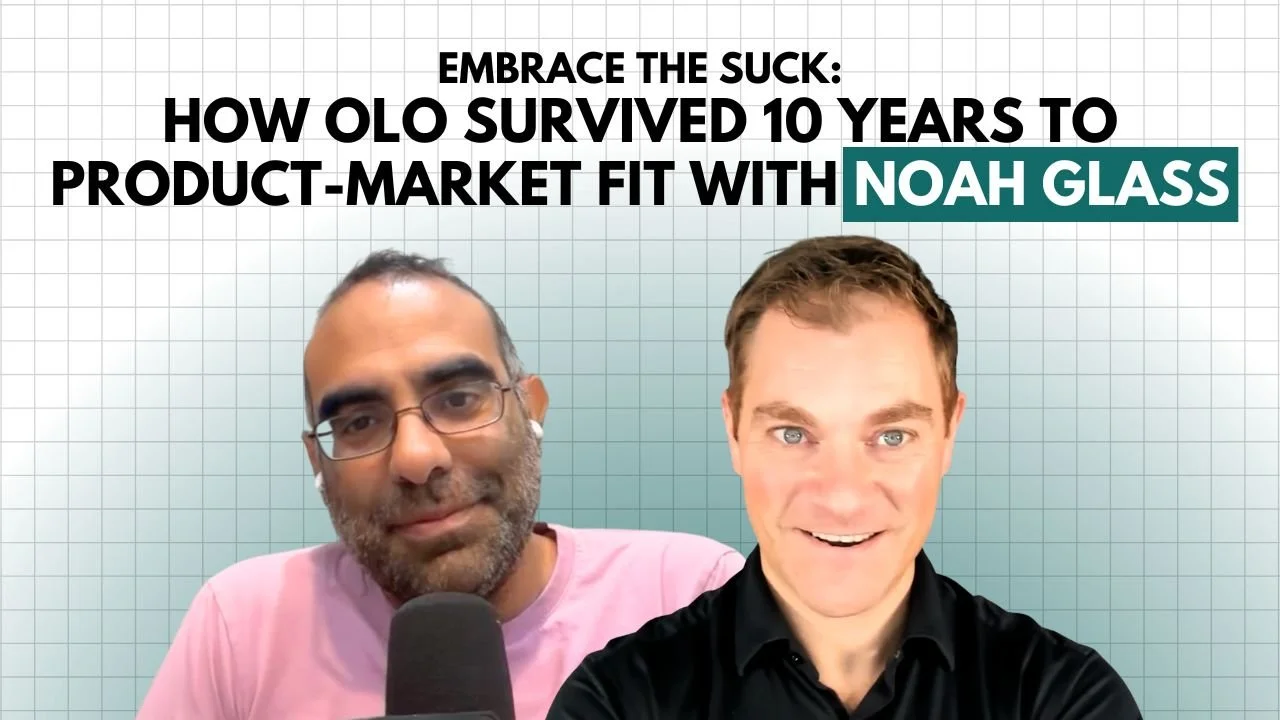
Olo founder Noah Glass shares lessons from a 20-year journey building enterprise restaurant software, finding product-market fit, and scaling through persistence.
In this episode of the Founders in Arms podcast, we sit down with Noah Glass, founder and CEO of Olo, to discuss what it really takes to build an enduring company over decades.
Noah shares the story of building Olo over 20 years—from the early days of mobile ordering before smartphones existed, to finding product-market fit after nearly a decade, to scaling into a public company and eventually partnering with private equity.
This is a rare look at long-term company building, persistence, and the realities of enterprise SaaS.
This conversation dives deep into:
What it takes to survive 10 years before product-market fit
Why “embrace the suck” became Olo’s core philosophy
The transition from B2C to B2B SaaS
How to win in enterprise software
Why speed is overrated in some startups
Building trust and reliability in enterprise markets
Lessons from going public and operating under private equity
How to think about market size in vertical SaaS
Why most founders underestimate enterprise complexity
In this episode, we cover:
(00:00) “Embrace the suck” — surviving the early years
Noah describes the first 8–10 years of Olo as constant struggle.
The team adopted a simple mantra:
Embrace the suck.
This mindset helped them push through setbacks and stay motivated despite slow progress.
(01:03) A decade-long wait for product-market fit
Olo launched mobile ordering before smartphones were mainstream.
At the time:
Less than 5% of users had smartphones
Consumers weren’t ready
The market hadn’t caught up
It took nearly 10 years for the vision to become viable.
(03:51) What Olo actually does
Olo is not a consumer marketplace like DoorDash.
Instead, it provides:
Enterprise software for restaurant brands
Infrastructure for ordering, payments, and delivery
Tools powering apps and websites for major chains
(05:27) Why “grow fast or quit” doesn’t always apply
Modern startup advice emphasizes early hypergrowth.
But Noah’s journey shows:
Some companies take years to mature
Timing matters as much as execution
Persistence can be a competitive advantage
(06:06) The power of early team culture
The early Olo team built deep bonds through shared struggle.
Many team members:
Stayed for nearly two decades
Built lifelong relationships
Grew alongside the company
(08:21) Why relationships matter long-term
Noah emphasizes treating early employees with care.
Key lesson:
How you part ways matters just as much as how you hire.
Reputation compounds over a long career.
(12:19) B2C vs B2B — finding the right model
Olo started as a B2C company.
The problem:
High customer acquisition costs (~$15 per user)
Unclear lifetime value
This made the model unsustainable.
(13:35) The pivot to enterprise SaaS
A key insight came from restaurant partners:
Restaurants could bring their own customers.
This led Olo to:
Shift to B2B
Build white-labeled solutions
Focus on enterprise brands
This pivot unlocked scale.
(17:24) Why B2B was fundamentally better
After the pivot:
Customer acquisition flipped from cost to revenue
Growth accelerated significantly
The business became profitable
The same effort produced dramatically better outcomes.
(19:06) Product-market fit is a maze
Many founders start with a product insight—but not a business model.
Finding product-market fit often requires:
Multiple iterations
Model changes
Strategic pivots
(20:46) The rise of delivery and a second inflection point
Olo’s next breakthrough came with delivery infrastructure.
By integrating with platforms like DoorDash:
Restaurants could offer delivery without building logistics
Olo added a new product layer (Dispatch)
Growth accelerated significantly
(23:56) Building a multi-product platform
Olo expanded from one product to many:
Ordering
Dispatch (delivery)
Rails (marketplace integrations)
Today, it offers 16+ modules.
(24:22) Going public — the pros and cons
Olo IPO’d in 2021.
Benefits:
Raised over $500M
Increased credibility with enterprise customers
Challenges:
Market volatility
Short-term pressure from quarterly reporting
(27:14) Why going public helped enterprise sales
Being public signaled:
Stability
Long-term commitment
Reliability
This helped win large customers who needed mission-critical partners.
(30:11) Public vs private — tradeoffs
As a public company:
Constant investor communication
Short-term performance pressure
Regulatory complexity
As a private company:
More focus on long-term building
Less distraction
Tighter, more aligned board
(33:50) The advantage of private equity ownership
Under Thoma Bravo:
Deep expertise in enterprise software
Strong pattern recognition
Focus on business building, not just financial engineering
(38:48) How to break into enterprise markets
Key strategies:
Build credibility through advisors
Leverage industry relationships
Deliver strong early case studies
Enterprise trust must be earned.
(41:04) Reliability is everything
Enterprise customers prioritize:
Reliability at scale.
This means:
Systems cannot fail
Support must be excellent
Trust must be absolute
(44:50) Thinking about market size in vertical SaaS
Even narrow verticals can be large:
US restaurant industry: ~$1.5 trillion
Expansion opportunities: new products, geographies, segments
Growth comes from both:
Product expansion
Market expansion
(48:53) A key leadership lesson: loyalty vs performance
Noah received feedback that he was overly loyal.
Lesson:
Loyalty is valuable
But performance still matters
Balancing both is critical.
(50:35) A passing fad: building your own tech stack
Many companies want to build internal tools instead of buying SaaS.
Noah argues this is a mistake:
Maintenance is costly
Reliability is hard
SaaS exists for a reason
Key Takeaways for Founders
Great companies can take a decade to emerge
Not every startup fits the “grow fast or die” model.
Timing matters as much as execution
Olo was early—and had to wait for the market to catch up.
Business models matter more than ideas
The shift from B2C to B2B unlocked everything.
Enterprise success is built on trust
Reliability, support, and stability are non-negotiable.
Persistence is a real competitive advantage
Most companies quit before the market turns in their favor.
Expand through products, not just markets
Vertical SaaS companies can grow by deepening their offering.
About the Guest
About Noah Glass
Noah Glass is the founder and CEO of Olo, a leading enterprise SaaS platform for the restaurant industry.
He founded the company in 2005 and led it through two decades of growth, an IPO in 2021, and a successful acquisition by Thoma Bravo.
Listen to Founders in Arms
Founders in Arms is a podcast for ambitious builders—covering startups, AI, marketplaces, leadership, and the realities of building enduring companies.
🎙 Subscribe to Founders in Arms Podcast on your favorite platform
💬 Join the conversation at TribeChat.com
🚀 Explore more founder stories and insights
