
10 Reasons Edgewood Park Is the Bay Area's Best Kept Hiking Secret
It's two minutes off the 280. It has rare butterflies, volcanic soils, and wildflower fields that look nothing like the rest of California. And somehow, most people have never heard of it.
Somewhere between Redwood City and the Crystal Springs Reservoir, tucked just off I-280, sits a park that most Bay Area residents have driven past hundreds of times without stopping. Edgewood Park & Natural Preserve doesn't look like much from the freeway — a low ridge, some golden hills, a sign. But pull off and walk in, and you'll find yourself in one of the most ecologically strange and genuinely beautiful places on the entire Peninsula.
This is not your average Bay Area hike. Edgewood is San Mateo County's only natural preserve, and what makes it worth that designation is something you have to learn to see. The trails are accessible. The parking is free. The wildflower season can be genuinely breathtaking. And the ecology is unlike anything else in the region.
Here are ten things that make Edgewood Park worth your Saturday morning.
1) Geology
The soil here is literally toxic — and that's the whole point
The secret behind almost everything that makes Edgewood special is a word you'll want to know: serpentine. About 160 acres of the preserve sit on ancient serpentinite rock — the kind of substrate formed when oceanic crust from the Farallon tectonic plate was thrust to the surface millions of years ago. Serpentine soils are low in nutrients and high in heavy metals like nickel and magnesium, making them inhospitable to most plants. That toxicity is, paradoxically, what keeps invasive species out — and what gives native California plants a rare foothold. Serpentine outcrops cover just 1% of California's land, but they're home to roughly 12% of the state's endemic species. When you're walking the Serpentine Trail, you're walking on geologic history.
2) Wildflowers
The spring wildflower display is one of the best on the Peninsula
If you've never seen Edgewood in bloom, it can be genuinely startling. From roughly late February through May, the serpentine grasslands go dense with color — California poppies, blue dicks, goldfields, clarkia, owl's clover, and dozens of others lighting up the hillsides all at once. The density of the bloom is a direct result of those unusual soils: because invasive grasses can't dominate, native wildflowers have space to spread and thrive. The Serpentine Trail and Sunset Trail are the prime viewing corridors, though in a good year, you'll find flowers almost everywhere. Even in a dry year, the display is more varied and interesting than what you'd see in a typical Bay Area open space.
3) Wildlife
It's one of the last places in the Bay Area where you might see a Bay Checkerspot Butterfly
Once widespread throughout the Bay Area, the Bay Checkerspot Butterfly — a striking orange, black, and white species — is now federally threatened and found in only a handful of locations in San Mateo and Santa Clara counties. Edgewood is one of them. In caterpillar form, it feeds almost exclusively on California plantain and owl's clover, both of which grow in Edgewood's serpentine grasslands. Seeing one in the wild is a genuine privilege. Spring is your window — look for them in the open, sunny grassland areas on warm, calm days. Beyond the checkerspot, the preserve supports foxes, coyotes, bobcats, deer, over 80 species of birds, and even the occasional mountain lion.
4) Views
The summit at Inspiration Heights earns its name
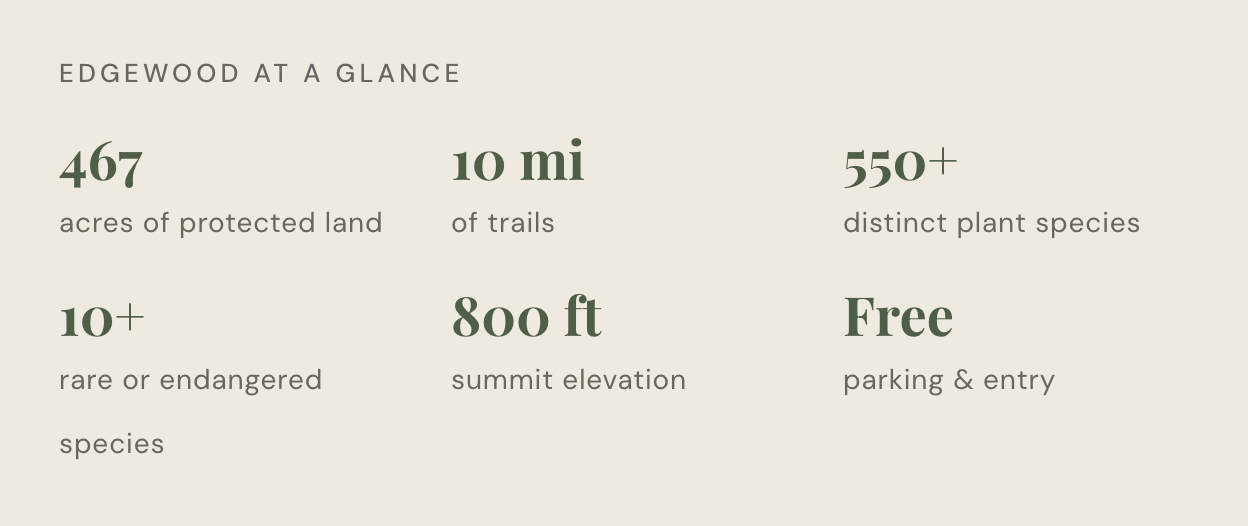
The preserve's main ridge — known as Inspiration Heights — tops out at 875 feet. It's not a grueling climb, but it earns you a view that stretches across the entire Peninsula. On clear days you can see the San Francisco Bay, the Dumbarton Bridge, Mount Diablo to the east, Skyline Ridge and the Santa Cruz Mountains to the west, and the Crystal Springs Reservoir glinting below. The San Andreas Fault Zone traces directly through the valley beneath you. For a preserve that fits inside 467 acres, it punches well above its weight for panoramic scenery.
5) Rare Plants
Over a dozen rare and endangered plant species call this park home
Among the more than 550 plant species at Edgewood, at least ten to twelve are rare or endangered — including the San Mateo thornmint and the white-rayed pentachaeta, both found almost nowhere else on Earth. The thornmint, in particular, is a San Mateo County endemic: small, incredibly fragrant, and restricted almost entirely to serpentine chaparral. Walking past it without knowing what it is, you'd think it was a weed. Walking past it with a naturalist who can explain what you're looking at — that's a different experience entirely. This is one of those places where knowledge transforms the landscape.

Join us on May 17th, from 3-5pm at Edgewood Park for a premium, guided hike with 2 nature docents!
In partnership with Friends of Edgewood, Bay Area Hiking/Walking, and Parenting Tips!
Sign up here!
6) Ecology
Four distinct habitats in one small park
What makes Edgewood genuinely interesting for naturalists is that it compresses four distinct plant communities into a relatively small space: serpentine grassland, oak woodland, chaparral, and coastal scrub. Transition between them is quick and dramatic — shaded oak canopy giving way to open golden grassland, then into dense chaparral with manzanita and chamise. Each zone has its own cast of species, its own light, its own smell. The Sylvan Trail is the best introduction to the oak woodland; the Serpentine and Sunset Trails get you into the grasslands; the Clarkia Trailhead takes you through the chaparral to the south. If you can do all three in one outing, do it.
7) History
It almost became a golf course — and a community fought to save it
In the early 1980s, San Mateo County approved plans to build an 18-hole golf course on this land. What followed was a 25-year conservation battle, anchored in part by Suzanne Somers — a local resident who had been quietly documenting hundreds of plant species on the site since the 1960s, including several that turned out to be endangered. She helped form the Save Edgewood Park Coalition, which ultimately gathered 15,000 signatures and presented them to the Board of Supervisors. In 1993, the county unanimously designated Edgewood as a natural preserve. It's the only one in San Mateo County. Walking these trails, you're walking land that people genuinely fought for.
8) Trails
The trail system is well-designed for any pace or duration
Ten miles of trails spread across the preserve, ranging from the easy Sylvan loop (great for families with young kids) to the longer Edgewood-Serpentine-Franciscan-Baywood Glen loop at about 4 miles with solid elevation gain. Trails are well-signed and maintained, and free maps are available at the Education Center kiosk near the main entrance. The park is open to hikers and equestrians; mountain bikes are not permitted on any trails. Note: dogs are also not allowed in the preserve, which actually makes a difference for wildlife viewing — animals are noticeably less skittish here than in parks where dogs roam.
9) Accessibility
It's genuinely easy to get to — and easy to return to
The main entrance at 10 Old Stage Coach Road in Redwood City is two minutes off I-280 at the Edgewood Road exit. Free parking at the main lot fills quickly on spring weekends (arrive before 9 a.m. or plan for street overflow). An alternative trailhead at the Clarkia entrance off Cañada Road gives you a different entry point with a bit more parking flexibility. The park opens at 8 a.m. daily; closing times are seasonal and posted at the gate. No entry fee. No dog fee because there are no dogs. Just show up.
10) Community
It's one of those places that rewards coming back — especially with someone who knows it
Edgewood is one of those rare parks that reveals itself slowly. You can walk the same trail in February and again in April and feel like you're in a completely different place. Experienced naturalists and docents from Friends of Edgewood offer guided walks throughout the year, and the difference between walking alone and walking with someone who can name what you're looking at — explain why that plant is growing there and not six inches to the left, or identify the call overhead — is genuinely significant. The park rewards curiosity, and curiosity rewards having a good guide.
Don’t forget to sign up for our guided hike with 2 nature docents on May 17th! Registration can be done here: https://luma.com/zfqd3188
