
The Best Bay Area Padel Courts for Beginners: An Honest Guide
The Best Bay Area Padel Courts for Beginners: An Honest Guide
So… someone talked you into trying padel. Maybe it was a coworker, maybe you kept seeing it on Instagram, maybe you walked past the Embarcadero courts and got curious. Whatever brought you here, welcome to the rabbit hole. Fair warning: most people who try padel once end up booking their own court before the week is out. The sport has a 92% return rate globally and honestly, once you feel the ball come off the glass the right way, you'll understand why.
But here's the thing nobody tells you upfront. The Bay Area padel scene, as exciting as it is right now, can feel a little intimidating to walk into cold. The venues are spread out. Some are better suited to beginners than others. Open play is amazing once you know what you're doing and genuinely confusing before that. And showing up to your first session without any context can mean 90 minutes of accidentally getting in people's way while pretending you understand the rotation.
This guide is here so that doesn't happen to you. Here's an honest, venue-by-venue breakdown of where to start and what to expect when you get there.
Park Padel at the Embarcadero: Best for Zero-Pressure First Experiences
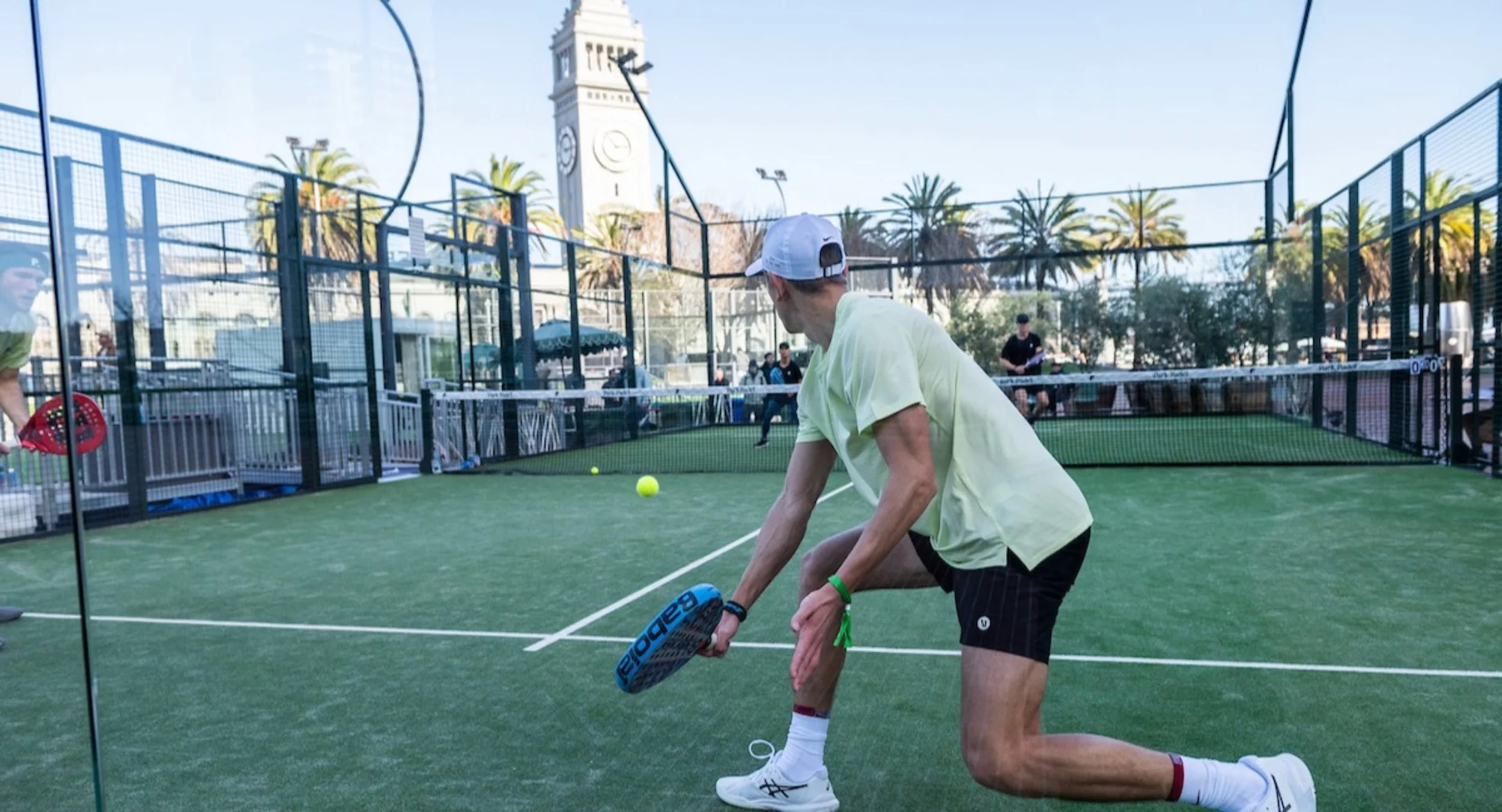
If you've never touched a padel paddle in your life, the Embarcadero courts are probably your best first stop. Park Padel runs free community hours Monday through Thursday, which takes the financial commitment completely off the table for a sport you're still deciding whether you love. The outdoor setup right on the waterfront with Bay views means even a session where you're mostly confused about the rules is still a genuinely nice way to spend an afternoon.
The crowd at Embarcadero open play skews friendly and mixed-level, which is honestly what you want when you're new. Nobody is trying to qualify for anything. People are generally patient about explaining the wall rules and the rotation format to newcomers, and the "anyone can join" nature of the free hours means you're not the only person there who looks slightly lost.
The one honest caveat: outdoor padel plays differently than indoor. The wind off the Bay affects the ball more than you'd expect, and some shots that would work perfectly in an enclosed court become unpredictable outside. You'll still learn the fundamentals just fine here, but don't be surprised if your indoor game feels slightly different when you make the transition.
What to know before you go: Book through Playtomic for the paid sessions (and coordinate matches + find partners on Tribe). For free community hours, just show up (but get there early because spots fill up). Parking nearby is rough so BART to Embarcadero and walking is genuinely the move.
Bay Padel Treasure Island: Best for Structured Learning
Treasure Island is the flagship Bay Area padel experience and walking into that converted historic hangar for the first time is genuinely one of the more memorable moments in Bay Area sports. Six indoor courts under 85-foot ceilings, the SF skyline visible across the water from the parking lot, and a facility that feels like it was designed by someone who actually loves the sport. Which, as it turns out, it was (Bay Padel's founder Matias Gandulfo grew up playing in Argentina and built exactly the kind of club he wished existed when he moved to SF).
For beginners specifically, Treasure Island is the strongest option for structured improvement. The coaching program is organized, the beginner clinics actually teach you things in a logical sequence, and the indoor environment means the ball behaves consistently while you're still learning to read it. There's also just more going on here in terms of community. More players, more skill levels represented, more chances to get pulled into a pickup game by someone who's happy to play with a newcomer.
The honest tradeoff is cost and logistics. Getting to Treasure Island requires a car or a rideshare (there's no BART option) and the court fees and membership are higher than the Embarcadero. For someone who's already pretty confident they're going to love padel, the investment makes complete sense. For someone still on the fence, starting at the free Embarcadero sessions first and then graduating to Treasure Island feels like the smarter path.
What to know before you go: Check the Bay Padel website for beginner clinic schedules before you go. Open play is available too but the clinics are worth doing first if you've never played. Budget for rideshare and factor in that the island location means you're committing to the round trip.
Bay Padel Dogpatch: Best for the Boutique Experience
The Dogpatch location is Bay Padel's smaller, more neighborhood-feel venue at Pier 70, and it has a charm that the bigger facilities can't quite replicate. Two courts, a proper gym alongside them, a pro shop, showers and lockers, and the kind of staff-to-player ratio that means you actually get attention when you need it. It's the spot where you're most likely to recognize faces from week to week and start to feel like a regular quickly.
For beginners, the smaller scale is actually an advantage. Less to navigate, more intimate vibe, and a community that's tight enough that someone will almost always help you figure out what you're doing if you look slightly confused (which you will, at least the first time). The Dogpatch and Potrero Hill crowd that uses this location tends to be local and loyal, which gives it a different energy than the more transient feel of open play at a bigger facility.
The pet-friendly policy is also genuinely delightful if that matters to you, which for a lot of SF residents it very much does.
What to know before you go: Two courts means booking in advance is more important here than at Treasure Island. Don't just show up hoping to get on a court, especially on weekends. Book through Bay Padel's website or app ahead of time.
Oyster Point, South San Francisco: Best for the Peninsula
If you're based south of the city and the Treasure Island or Embarcadero commute doesn't work for you, Oyster Point is the answer. Six indoor courts with 28-foot ceilings, a perfect 5.0 star rating across reviews, and a facility that's genuinely modern without feeling sterile. The South San Francisco location makes it the most practical option for anyone coming from San Mateo, Burlingame, or the northern Peninsula.
The 5.0 rating is worth taking seriously. That kind of consistency across reviews usually means the operations are tight, the staff are good, and the courts are well-maintained. For beginners who are already dealing with the learning curve of a new sport, showing up somewhere that runs smoothly removes one layer of friction.
It's not the most glamorous venue in the Bay Area padel scene and it doesn't have Treasure Island's dramatic setting, but for regular play it might be the most reliable option on the Peninsula.
What to know before you go: Book early. The courts fill up on evenings and weekends and there aren't many alternatives nearby if you miss a slot.
Bay Padel Sunnyvale: Best for Silicon Valley
Four indoor courts next to Google's Sunnyvale campus, and (full transparency) this is the location where padel-as-networking is most visibly happening. The tech community's embrace of padel is real and probably most concentrated here, which depending on your perspective is either a feature or something to be aware of.
For beginners in the South Bay who don't want to drive to SF, this is the practical choice. The facility is well-equipped, the pro shop is stocked, and the fitness zone alongside the courts makes it easy to build padel into a broader workout routine rather than treating it as a standalone trip.
What to know before you go: Playtomic for bookings. The Google campus adjacency means weekday lunchtime and after-work slots move fast.
Honest Beginner Tips That Apply Everywhere
Before you go anywhere, download Playtomic. It's the app most Bay Area courts use for bookings and it also has a match-finding feature where you can post that you're looking for players at your level. As a secondary option, you can also connect with other players in the Bay Area Padel Community on Tribe Chat.
Don't overthink the rules before your first session. Padel uses the same scoring as tennis. The main thing to understand going in is that the ball can bounce off the glass walls and still be in play, that you're always playing doubles, and that letting it hit the back wall before you return it is completely fine (and often the right move). You'll absorb the rest naturally within the first 30 minutes.
Show up to open play sessions willing to play with anyone. The fastest way to improve and the fastest way to find your people in the Bay Area padel scene is to say yes to every pickup game, regardless of level mismatch. The community here is genuinely welcoming to beginners and most experienced players are happy to adjust when someone new joins a rotation.
And join the Bay Area Padel Community on Tribe Chat before your first session if you can. Post your level, your location, and when you're thinking of going. Odds are good someone in the community will either join you, have tips about that specific venue, or both.
The Bay Area padel scene is at a genuinely exciting moment. The courts are good, the community is warm, and you're getting in early enough that you'll seem like a veteran in about 18 months when everyone else is discovering it. Start at whichever venue makes the most logistical sense for you, go twice before you decide whether you love it, and then come find your people in the community.
Check out our latest blog pieces on Padel
Padel Gear Guide for Bay Area Players: What's Actually Worth Buying
How to Find a Padel Partner in the Bay Area: The Honest Guide
Why Padel is Replacing Golf as the Bay Area's Networking Sport
